A Complete Guide to Jaw Expansion Appliances for Children
09/01/2026 16:17
20/08/2026 16:38
Seeing your child's adult teeth come in is exciting, but it can also be worrying. The new teeth often look much bigger than the baby teeth they replace. Sometimes, they come in twisted, overlapping, or crowded together. You might notice the "shark tooth" effect, where permanent teeth appear behind baby teeth because there isn't enough space in the jaw.
Many parents first think, "My child has too many teeth." However, orthodontists often find the real issue is not too many teeth, but not enough space in the jaw.
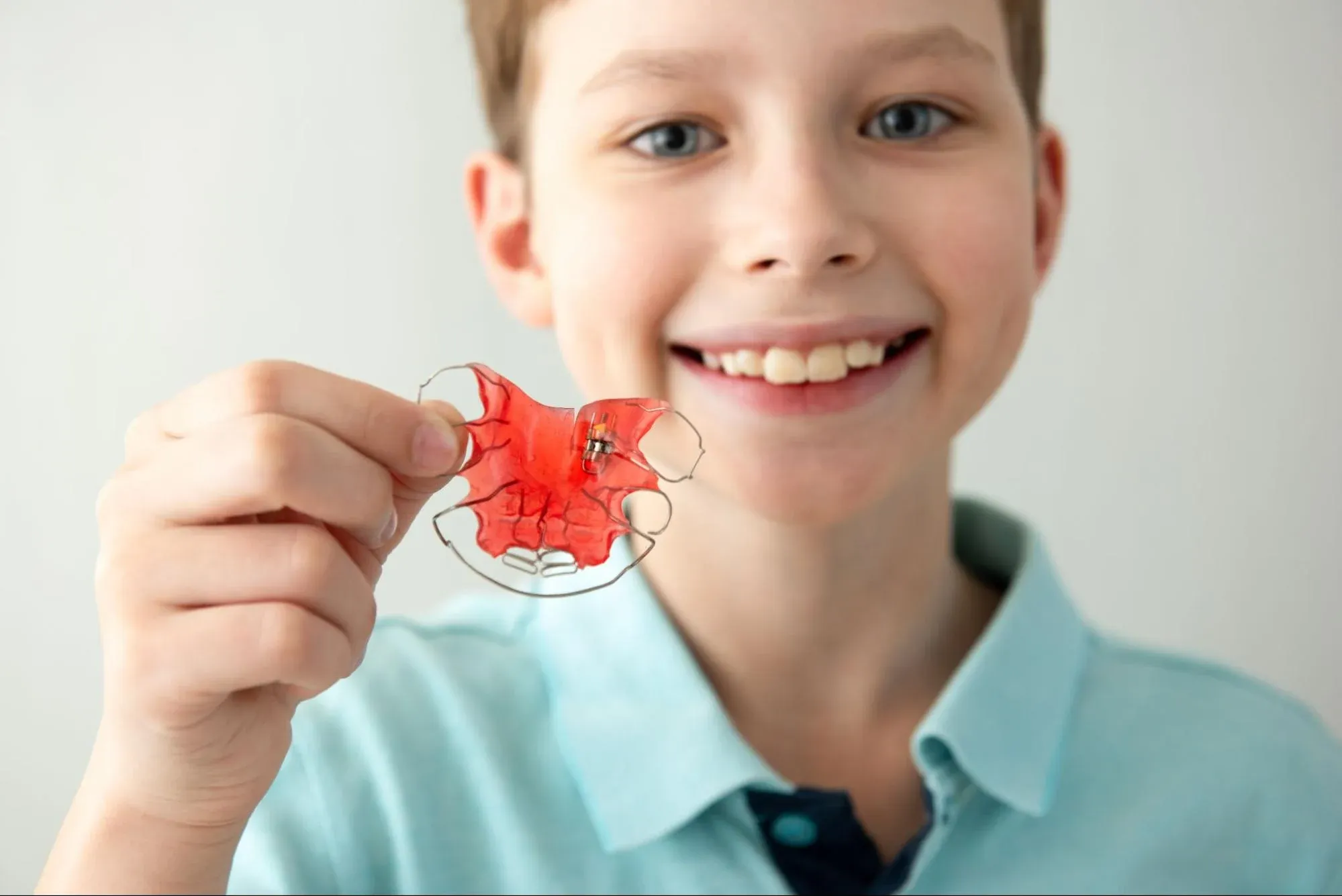
This is where a key tool in pediatric orthodontics helps: the Jaw Expansion Appliance, or Palatal Expander. Unlike braces, which move teeth, an expander changes the shape of the jaw itself. It creates new space, widens the smile, and can fix bite problems before they become permanent. In this article, we explain what an expander is, why it is used, and how it can improve your child's dental and breathing health.
The Anatomy of the Problem: The Narrow Maxilla
To see why expansion is needed, let's look at the roof of the mouth, called the maxilla or upper jaw.
In a perfectly developed jaw, the upper arch should be shaped like a wide horseshoe. It should be broad enough to house all the permanent teeth without crowding. Furthermore, like a lid on a box, the upper jaw should be slightly wider than the lower jaw. When the child bites down, the upper teeth should fit outside the lower teeth on all sides.
But because of genetics, thumb-sucking, or mouth breathing, many children develop a narrow upper jaw. The arch turns V-shaped instead of U-shaped. This causes two main problems:
-
Crowding: There is insufficient perimeter bone to accommodate the larger adult teeth.
-
Posterior Crossbite: Because the "lid" (upper jaw) is too narrow for the "box" (lower jaw), the child has to shift their jaw to one side to bite comfortably. This causes the upper back teeth to sit inside the lower teeth.
What is a Palatal Expander?
A Palatal Expander is a custom orthodontic device that widens the upper jaw. In children, the upper jaw is made of two bones joined in the middle by a seam called the mid-palatal suture, not a single solid bone.
Before puberty, this suture is soft and has not yet ossified (turned to solid bone). This means the two halves of the jaw can be gently separated.
The Design: The most common type, the Rapid Palatal Expander (RPE), consists of a small screw mechanism encased in a metal framework. This framework is connected to bands (metal rings) cemented to the child's upper molars. The device sits high up on the roof of the mouth, hidden behind the teeth.
When is it used? The Diagnostic Signs
Orthodontists generally recommend an expander during the "mixed dentition" phase (when the child has both baby and adult teeth), typically between ages 7 and 10. The goal is to intervene before the mid-palatal suture fuses, which happens during puberty.
Here are the primary scenarios where an expander is the treatment of choice:
1. Posterior Crossbite This is the most important reason for an expander. If a child's upper jaw is too narrow, they may move their lower jaw to the side to bite properly. If not treated, this can cause the lower jaw to grow unevenly, leading to facial asymmetry. An expander widens the upper jaw so the lower jaw can return to the center, preventing lifelong jaw joint (TMJ) issues and facial imbalance.
2. Severe Crowding In the past, dentists often removed healthy teeth to make space. Now, the goal is to keep all natural teeth. By widening the jaw, an expander creates enough room for all permanent teeth to come in, so extractions are usually not needed.
3. Impacted Teeth Sometimes, a permanent tooth, often the upper canine, gets stuck in the bone because there isn't enough space. Expanding the jaw creates room so the tooth can come in naturally.
4. Breathing Issues (The Airway Connection) Many parents are surprised to learn that the roof of the mouth is also the floor of the nose. A high, narrow palate can make the nasal passages tight, causing mouth breathing, snoring, or even sleep apnea. Expanding the palate also widens the nasal passages. After treatment, many parents notice their child breathes better, sleeps more soundly, and focuses better at school.
The "Turning" Process: Demystifying the Fear
The part of palatal expanders that worries parents most is the "key." Parents use this key to activate the expander at home.
How it works: The expander has a small hole in the center screw. You get a special key to use. Once a day, usually at bedtime, you put the key in the hole and turn it toward the back of the mouth until a new hole shows up.
-
Each turn is very small, usually moving the screw only 0.25 millimeters.
-
Does it hurt? Usually not. Most children feel some pressure or tightness in their nose or cheeks for a few minutes, but rarely any sharp pain.
The active phase, when you turn the key, usually lasts 2 to 4 weeks. After reaching the right width, you stop turning the key, but the expander stays in place for another 4 to 6 months. This holding phase lets new bone grow and keeps the jaw stable.
A Sign of Success
About a week into the treatment, parents will notice a space opening up between the child's two front teeth (a diastema). Do not panic. This gap is actually a cause for celebration. It is visual proof that the appliance is working! It means the two halves of the jawbone have successfully separated, and the expansion is skeletal (bone movement) rather than just dental (tipping teeth).
After you stop turning the key, the teeth will naturally move back together, and the gap will close or get much smaller within a few months.
Tips for Parents
The first few days with an expander take some getting used to. Because the device sits on the roof of the mouth, your child's tongue needs to adjust.
-
Speech: Your child may have a slight lisp or sound like their mouth is full. Please encourage them to read aloud; the tongue usually adapts within 3 to 5 days, and speech returns to normal.
-
Eating: The appliance can trap food. For the first week, stick to soft foods (pasta, yogurt, soup). Avoid sticky candies (caramel, taffy) or super-hard foods that could dislodge the metal bands.
-
Hygiene: A standard toothbrush might miss the area between the appliance and the palate. A "water flosser" is an invaluable tool for blasting out food particles trapped above the screw.
Removable vs. Fixed Expanders
While the fixed Rapid Palatal Expander is most common, there are other types too:
-
Schwartz Appliance: This removable device looks like a retainer with a screw. It's used for milder cases or to tip teeth, not to separate the jaw bones. The main drawback is that it only works if the child wears it as directed.
-
Quad Helix: This is a wire device that uses spring action instead of a screw. It works more slowly and doesn't need parents to turn a key.
Your orthodontist will choose the type of expander that fits your child's needs and maturity.
A Foundation for a Lifetime
People often overlook the importance of the Palatal Expander since it's usually just the first step in orthodontic treatment. But this device does essential work. By widening the jaw, it not only straightens teeth but also helps shape the face, improve jaw joint function, and keep the airway open.
Correcting a crossbite or narrow jaw at age 8 is usually simple and just means wearing an appliance for a few months. Fixing the same problem at age 25 often needs surgery. Early treatment is easier, less expensive, and better for your child's health.
Building a Broader, Healthier Smile
If your child has a narrow smile, crowded teeth, or often breathes through their mouth, seeing an orthodontist is a smart move. Jaw expansion is one of the most rewarding dental treatments because the results are easy to see and the health benefits are significant.
At İstinye University Dental Hospital, our pediatric orthodontists specialize in helping children’s faces grow properly. We use the latest digital scanning technology to make custom expanders that are comfortable and effective, so your child gets the space they need for a healthy, confident smile.