Silent Intruders: A Comprehensive Guide to Cysts and Tumor Operations of the Jaw
09/01/2026 16:36
20/08/2026 16:58
Not all jaw pain is a toothache. Discover the hidden world of jaw cysts and tumors—how to distinguish benign growths from severe pathology, the warning signs like painless swelling, and the advanced surgical techniques used to restore facial health.
- Distinguishing the Players: Cysts vs. Tumors
- The Silent Progression: Symptoms and Signs
- The Diagnostic Pathway: From Shadow to Certainty
- Surgical Interventions: Tailored Treatments
- The Art of Reconstruction
- Recovery and Surveillance
- Prevention: The Power of the Routine Check-up
- Restoring Peace of Mind
The human jaw is a dynamic landscape. It is constantly remodeling, subjected to the immense pressures of chewing, and teeming with the biological activity of tooth development. Because of this unique environment—specifically the complex cells involved in creating teeth—the jawbones (maxilla and mandible) are more prone to cysts and tumors than any other bone in the human body.
For a patient, hearing the words "cyst" or "tumor" in reference to their face is understandably terrifying. The mind often jumps immediately to the worst-case scenario. However, in the realm of oral and maxillofacial surgery, the reality is usually far more manageable. The vast majority of these growths are benign (non-cancerous). Yet, "benign" does not mean "harmless." Even a non-cancerous cyst can be a destructive force, silently expanding and dissolving the jawbone from the inside out like a slow-moving balloon.
Understanding the nature of these lesions, recognizing the subtle warning signs, and knowing that sophisticated surgical solutions exist is the antidote to fear. This guide delves into the pathology of the jaw, demystifying the diagnosis and detailing the precision surgeries that protect both the structure of the face and the life of the patient.
Distinguishing the Players: Cysts vs. Tumors
To understand the treatment, one must first distinguish between the two primary types of "intruders."
1. Jaw Cysts ( The Fluid-Filled Sacs) A cyst is essentially a balloon. It is a pathological cavity lined by tissue and filled with fluid, semi-fluid, or gas.
-
Origin: Most jaw cysts are "odontogenic," meaning they arise from the cells that form our teeth. When a tooth is developing, it is surrounded by a sac. If that sac doesn't dissolve properly, or if infection stimulates it, it can fill with fluid.
-
Behavior: Think of a water balloon inflating inside a rock. As the cyst fills with fluid, it creates hydraulic pressure. This pressure pushes against the surrounding bone, causing the bone to resorb (melt away) to make room for the cyst. They grow slowly but relentlessly.
-
Common Types:
-
Radicular Cyst: The most common type, caused by an infection in a dead tooth (usually from deep decay).
-
Dentigerous Cyst: Forms around the crown of an impacted tooth (usually wisdom teeth).
-
Keratocyst (OKC): An aggressive cyst known for its high recurrence rate and tendency to grow largely before being noticed.
2. Jaw Tumors (The Tissue Growths) A tumor (neoplasm) is a solid mass of tissue formed by abnormal cell division. Unlike a cyst, which is a balloon, a cancer is a solid lump.
-
Benign Tumors: These do not spread to other parts of the body (metastasis), but they can be locally aggressive. They can invade local bone and displace teeth. The most famous example is the Ameloblastoma, a tumor derived from enamel-forming cells that is notorious for its persistence and the need for wide surgical removal.
-
Malignant Tumors (Oral Cancer): These are cancers (Squamous Cell Carcinoma, Osteosarcoma) that invade tissue destructively and can spread to lymph nodes and other organs. While less common than benign lesions, they require immediate, aggressive, multimodal treatment.
The Silent Progression: Symptoms and Signs
The most dangerous aspect of jaw cysts and benign tumors is their silence. They are often painless in the early stages. A patient can walk around with a large cyst eating away half their jawbone and feel absolutely nothing because the growth is slow enough that the nerves aren't shocked.
Often, these lesions are discovered accidentally during a routine dental X-ray. However, as they expand, they present specific clues:
-
Painless Swelling: A hard, bony expansion of the jaw. The face may look asymmetrical, or the patient might notice their dentures no longer fit.
-
Loose Teeth: If the bone supporting the tooth is destroyed by the tumor, the tooth becomes mobile.
-
Tooth Displacement: The pressure can push teeth out of alignment, creating gaps.
-
Paresthesia (Numbness): If a lesion presses on the inferior alveolar nerve (in the lower jaw), the patient may feel tingling or numbness in the lower lip—an ominous sign that usually warrants immediate investigation.
-
Spontaneous Fracture: In severe cases, the jaw becomes so hollowed out that it snaps while eating regular food.
The Diagnostic Pathway: From Shadow to Certainty
Diagnosis is a process of elimination. It begins with imaging.
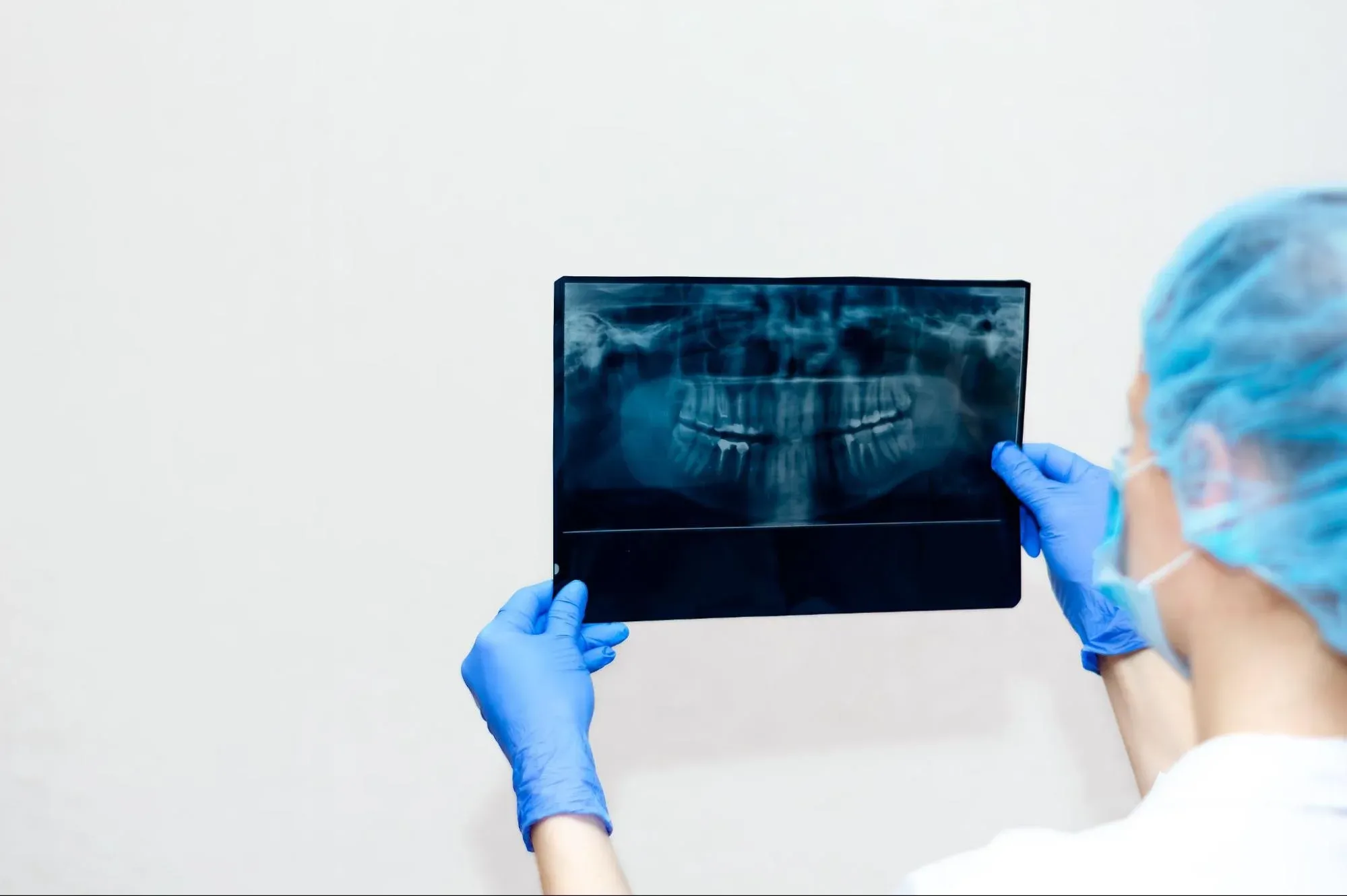
1. Radiographic Imaging: A standard panoramic X-ray shows the "shadow" of the lesion. Cysts usually appear as dark, well-defined circles (radiolucent), while tumors may occur as a mix of dark and white patches (mixed radiopaque-radiolucent) with irregular borders. For surgical planning, a 3D Cone Beam CT (CBCT) is mandatory. It allows the surgeon to see the exact size of the lesion, how much of the bone walls remain, and how close it is to vital structures such as the nerve canal or the sinus.
2. The Biopsy: X-rays provide a guess; a biopsy provides the truth. No treatment should proceed without knowing precisely what the tissue is.
-
Aspiration Biopsy: Inserting a needle to see if fluid comes out (indicating a cyst) or if it is solid.
-
Incisional Biopsy: Taking a small sample of the tissue to send to a pathologist.
-
Excisional Biopsy: Removing the entire small lesion immediately and sending it for testing.
The pathologist’s report dictates the surgery. A simple cyst is treated very differently from an aggressive ameloblastoma.
Surgical Interventions: Tailored Treatments
The goal of surgery is twofold: remove the pathology entirely and preserve or reconstruct the jaw function.
1. Enucleation and Curettage (For Cysts) This is the standard treatment for most cysts.
-
The Procedure: The surgeon opens the gum and creates a window in the bone. The cyst lining is carefully peeled away from the bony wall in one piece (enucleation), much like peeling an orange.
-
Curettage: After removal, the bony cavity is scraped (curetted) to ensure no cells are left behind.
-
Bone Healing: If the defect is minor, the body will naturally fill it with new bone. If it is large, bone graft materials may be packed into the void to speed up healing.
2. Marsupialization (Decompression) Used for huge cysts, especially in children, where removing the whole cyst might break the jaw or damage growing teeth.
-
The Technique: Instead of removing the cyst, the surgeon creates a small window into it and sutures the cyst lining to the gum. This keeps the cyst "open" to the mouth.
-
The Logic: By releasing the fluid pressure, the cyst begins to shrink on its own. Over months, the bone grows back, and the cyst becomes small enough to be easily removed in a minor second surgery.
3. Resection (For Aggressive Tumors) For aggressive benign tumors (like Ameloblastoma) or malignancies, simply scraping them out is not enough—they will grow back.
-
Marginal Resection: Removing the tumor along with a safe margin of healthy bone, while leaving the lower border of the jaw intact (maintaining continuity).
-
Segmental Resection: Removing a whole section of the jawbone. This creates a gap in the jaw continuity and requires reconstruction.
The Art of Reconstruction
When a large portion of the jaw is removed, we cannot leave the patient with a deformity or the inability to chew. Reconstructive surgery is performed immediately or in a second stage.
-
Bone Grafts: Harvesting bone from the patient's hip (iliac crest) or lower leg (fibula) to fashion a new jawbone.
-
Titanium Plates: Heavy-duty locking plates are used to bridge the gap and hold the remaining bone segments in place.
-
Microsurgery: In complex cancer cases, a "free flap" is used—transferring skin, muscle, and bone from the leg or arm along with its blood vessels, which are reconnected to the neck vessels under a microscope. This immediately restores blood supply to the new jaw.
Recovery and Surveillance
Recovery depends on the scale of the surgery.
-
Minor Cyst Removal: Similar to a wisdom tooth extraction. Swelling for a week, soft diet, and quick return to work.
-
Primary Resection: Hospital stay of several days, rigid fixation of the jaw, and a more extended rehabilitation period for speech and swallowing.
The Crucial Follow-Up: The surgery is not the end. Many jaw cysts and tumors have a high rate of recurrence. A keratocyst or ameloblastoma can return 5 or 10 years later. Therefore, patients must commit to annual radiographic monitoring for at least 5 years. This surveillance ensures that if the lesion returns, it is caught while it is still a speck, not a mass.
Prevention: The Power of the Routine Check-up
Can you prevent a jaw cyst? Not entirely, as many are developmental. However, you can avoid the destruction they cause. Most large, destructive cysts are found in patients who have avoided the dentist for years. A simple panoramic X-ray, taken every 3-5 years, can detect these lesions when they are millimetric and harmless. Furthermore, treating dead teeth (root canals) and removing impacted wisdom teeth early eliminates the two most significant sources of jaw cysts.
Restoring Peace of Mind
The diagnosis of a jaw lesion is a heavy burden, but modern oral and maxillofacial surgery transforms this burden into a curable condition. We have moved from the era of disfiguring surgeries to an era of precision, preservation, and regeneration.
The key lies in specialized care. These are not procedures for a general practice; they require the surgical acumen of a specialist who understands the biology of the head and neck. For patients navigating this diagnosis, İstinye University Dental Hospital stands as a center of excellence. With our advanced 3D diagnostic capabilities, in-house pathology collaboration, and expert surgical team, we provide a comprehensive pathway from accurate diagnosis to precise surgical removal and reconstruction, ensuring that your face, function, and future are in the safest hands.