Goodbye to Messy Impressions: Welcome to Digital Prosthetics and CAD/CAM Dentistry
12/01/2026 01:52
20/08/2026 16:55
- Decoding the Acronym: What is CAD/CAM?
- Step 1: The Intraoral Scanner (No More Gagging)
- Step 2: The Digital Design (The Architect’s View)
- Step 3: Milling and Sintering (The Sculptor)
- The "Same Day Teeth" Concept
- Why Digital is Better: The Patient Benefits
- The Sustainability Factor
- Is Digital Right for Everyone?
- The Human Touch in a Digital World
For years, getting a crown or bridge meant facing a dreaded part of the process: the dental impression.
The dentist would pick a tray that never seemed to fit, fill it with cold, sticky material that tasted odd, and press it into your mouth. You’d be told to breathe through your nose and sit for several minutes, trying not to gag, while the material set.
If the mold had a flaw, you had to repeat the whole process. After that, you’d wait about two weeks with a temporary tooth while your mold was sent to a lab.
Thankfully, we are living through a technological renaissance. The analog days of "goop and wait" are rapidly being replaced by the speed and precision of Digital Dentistry. Today, digital-assisted prosthetic solutions, powered by CAD/CAM (Computer-Aided Design / Computer-Aided Manufacturing) technology, have transformed the dental experience from an endurance test into a seamless, comfortable, and incredibly accurate process.
In this guide, we’ll show you how digital dentistry works. You’ll learn how intraoral scanners have replaced trays, how 3D printers and milling machines create your new teeth, and how you can get a permanent ceramic crown in just one visit.
Decoding the Acronym: What is CAD/CAM?
These terms may sound technical, but they are essential to modern dental care.
-
CAD (Computer-Aided Design): This is the digital architecture phase. Instead of a technician dripping hot wax onto a stone model to handshape a tooth, the dentist or technician designs the tooth in a 3D software program. They can zoom in 50x, rotate the tooth, and perfect the contact points with a mouse click.
-
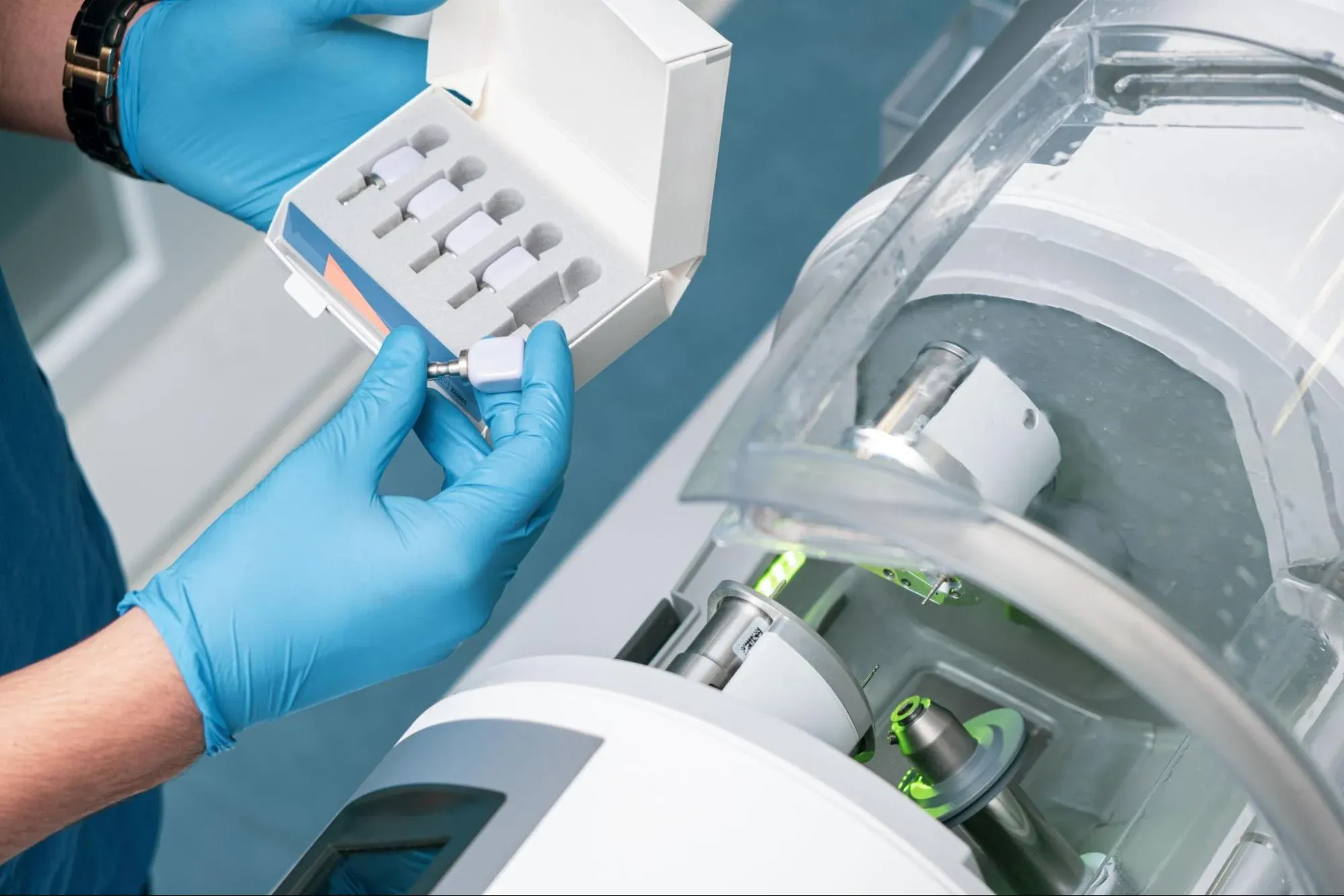
CAM (Computer-Aided Manufacturing): This is the construction phase. The digital design is sent to a milling machine (a high-tech carving robot). This machine takes a solid block of ceramic (Zirconia or E-Max) and carves the tooth out of it with micron-level precision, often in under 15 minutes.
Step 1: The Intraoral Scanner (No More Gagging)
The process begins with a digital impression. Instead of using trays and putty, the dentist uses an intraoral scanner, which looks like a large electric toothbrush. As the dentist moves it around your mouth, it uses safe light to take thousands of pictures and creates a 3D image instantly.
The Experience:
-
Comfort: The wand is small. It doesn't touch the back of your throat, so it doesn't trigger the gag reflex.
-
Speed: Scanning your whole jaw takes just 2 to 3 minutes.
-
Interaction: You can watch a TV screen as a 3D color model of your own teeth appears instantly. It is often the first time a patient truly understands their own dental anatomy.
-
Precision: Putty can distort or shrink. Digital scans are exact. If the dentist misses a spot, the software alerts them immediately, and they can rescan just that tiny area without having to start over.
Step 2: The Digital Design (The Architect’s View)
After the scan, the data is sent electronically—no need to mail anything. Sometimes, it stays right in the room. The dentist opens the file on the computer and starts customizing your new tooth.
-
A virtual tool simulates how your jaws move, making sure your new crown fits well and doesn’t affect your bite.
-
The software includes a library of natural tooth shapes. The dentist picks one that matches your age and face, then adjusts it as needed, even making small changes with great accuracy.
-
Margin Integrity: The most critical part of a crown is the "margin"—where the ceramic meets your tooth/gum. If there is a gap here, bacteria can get in and rot the tooth from the inside. Digital zooming allows the dentist to mark this line with accuracy thinner than a human hair (approx. 20-50 microns).
Step 3: Milling and Sintering (The Sculptor)
With one click, the design goes to the milling machine.
-
The Block: A strong, flawless ceramic block is placed in the machine.
-
The Carving: Diamond tools shape the crown from the block in about 10 to 20 minutes.
-
The Finishing: Depending on the material, the crown may be baked in a furnace to get its final strength and color. Then it’s polished or glazed to look like a real tooth.
The "Same Day Teeth" Concept
With in-office scanning and milling, you can now get a crown or small inlay in just one visit instead of two.
-
9:00 AM: You arrive. The tooth is prepared (drilled).
-
9:30 AM: The digital scan is taken.
-
9:45 AM: You take a break. Read a magazine, check emails, or watch the milling machine carve your tooth in the lobby.
-
10:30 AM: Your permanent crown is placed. You go home with no temporary crown, no second injection, and no need for another visit.
Note: More complex cases, like bridges or full smile makeovers, still need some lab work for artistic details. However, digital tools make this much faster—often just a few days instead of weeks.
Why Digital is Better: The Patient Benefits
It’s not just about new technology. The results for patients are actually better.
1. Superior Fit and Longevity: Crowns often fail because of leaks. Traditional methods can introduce small errors, but digital milling removes these problems. The fit is so precise that the seal lasts much longer.
2. Preservation of Tooth Structure: Older crowns had to be thick to avoid bending. Modern ceramics are strong even when thin, so dentists can save more of your natural tooth.
3. Digital Storage: If you lose your night guard or chip a veneer, you don’t need a new impression. Your scan is saved online, so we can make a new one for you without another visit.
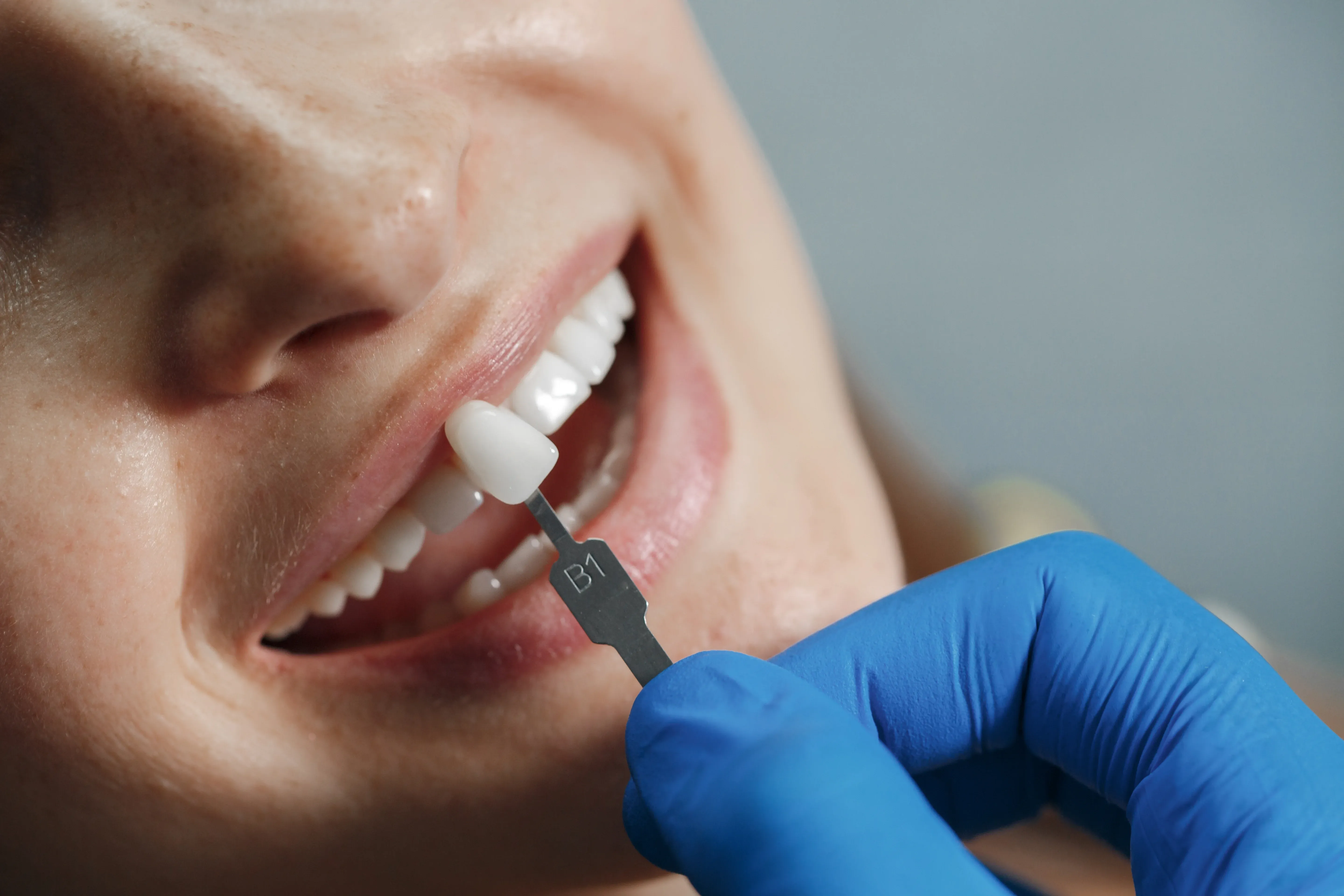
4. Communication: For cosmetic work, the dentist can show you a digital preview of your new smile by overlaying your 3D scan on a photo. You can see the results before any work begins.
The Sustainability Factor
Digital dentistry is also better for the environment.
-
No Waste: Digital dentistry gets rid of plastic trays, impression materials that end up in landfills, and bulky stone models.
-
Reduced Transport: Digital files are sent online, so there’s no need to ship molds back and forth, which lowers the carbon footprint.
Is Digital Right for Everyone?
Digital scanning is suitable for almost all cases.
-
Crowns and Bridges: The standard of care.
-
Implants: Essential for creating "Surgical Guides" that tell the surgeon exactly where to place the screw.
-
Invisalign/Aligners: The entire clear aligner industry is based on digital scanning.
-
Dentures: Even complete dentures are now being 3D printed for a better fit and suction.
The main limitation is with very deep cavities, where blood or gum tissue blocks the view. Cameras can’t see through blood like X-rays can, so in these rare cases, a traditional impression may still be needed.
The Human Touch in a Digital World
Some patients worry that technology makes dental care feel less personal. In fact, digital dentistry gives dentists more time to talk with you, plan your smile together, and focus on the artistic side of their work.
The machine is just a tool—the dentist is still the designer. The scanner’s accuracy helps the dentist achieve the best possible results.
Switching from old methods to digital dentistry is a big step forward for patient comfort. It saves you time, fits your mouth better, and makes the whole process easier, whether you need a small repair or a full reconstruction.
At İstinye University Dental Hospital, we use the latest digital technology, including intraoral scanners and in-house CAD/CAM milling. Combined with our prosthodontists’ skill, this means your dental work is done quickly, comfortably, and with the highest precision.